Conscious weddings in the Mayan jungle
A guide for couples who've outgrown the hotel wedding
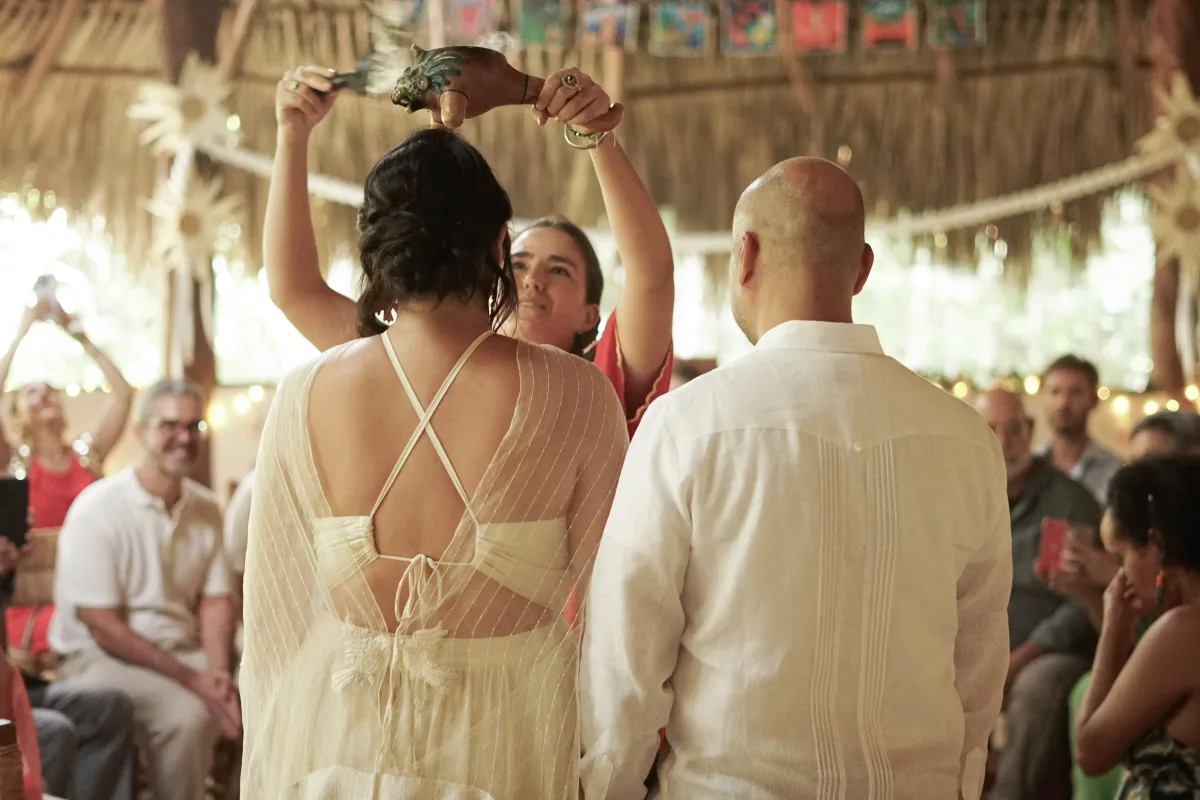
We’ve hosted two weddings at Casa Arkaana. That’s it. Two.
I’m telling you that up front because most venue websites open with “hundreds of couples” and a montage. We don’t have that. We have a five-acre piece of Mayan jungle, a temple, a cenote-fed pool, and a family that lives here.
Weddings weren’t part of our plan. Casa Arkaana was built as a retreat sanctuary — for facilitators, healers, groups doing deep work. What happened is that guests kept coming to see the property, feeling the energy of the land, and asking us if they could get married here. That’s how it started. It was — and still is — an honor. So we said yes, quietly, twice.
I want to say something else before you keep reading. Maja and I aren’t wedding beginners, even though the count on the property is small. Maja worked as an event manager in the UK for years — running events end to end, before Casa Arkaana. I ran catering in London for years. Between us we’ve produced a lot of things for a lot of people, we know how vendors think, we know how a day flows, we know what breaks and how. That production knowledge is behind everything you’ll read below, even the parts that sound simple.
Who this is actually for
Casa Arkaana is probably not for you if:
- You want 100+ guests, a big dance floor, and open bar until 5am. We’re not built for that scale.
- You want a wedding-in-a-box: hotel chapel, hotel dinner, hotel DJ, hotel photographer, everything handed to you. There are people in Tulum who do that well. We’re not one of them.
- You want a $50,000+ luxury wedding of the kind you’d have at some of the higher-end private villas. Different product, different price point, different customer.
Casa Arkaana might be for you if:
- You want to honor your commitment in a special, intimate way — where there’s ritual and celebration inside the same day. The ceremony matters to you. It’s where you lay your vows and your commitments down in front of the people you love. And then you want to be light enough to dance and celebrate all night with them.
- Your guest list is 20 to 100 people you actually know. Family, close friends. Not “should I invite them?” invitees.
- You want festival vibes more than luxury vibes. Fire, string lights, jungle sounds, real food, real music, real people, wearing what feels right. Moving from the fire to the dance floor to the food to the bar, connecting with different people all through the night.
- Sustainability isn’t a marketing checkbox for you — it’s part of how you already live. You want a venue that runs on solar, uses cenote water, cooks from a food forest, and doesn’t hide that behind polished marble.
If the second list feels more like you than the first, keep reading.
One important thing about how we work
We are not wedding planners. This matters.
Casa Arkaana rents the property to you. We can share what we know about the flow of a day here, what’s worked, what didn’t, which local vendors we trust. If you already have a planner, we work smoothly alongside them. If you don’t, you need to find one — a good wedding planner is the person who makes sure everything happens in the right order on the right timeline, and that role is theirs, not ours.
We’re happy to point you toward planners in the region who have worked with couples like the ones we host. But the responsibility for producing your day belongs to your planner and your team of vendors. Ours is the land, the temple, the pool, the setup, and the family energy behind the space.
What “conscious wedding” actually means (and doesn’t mean)
The phrase has been used enough that it’s starting to lose meaning. So let me tell you what we mean when we use it.
A conscious wedding isn’t a sober wedding. There’s mezcal and cocktails and wine — part of the celebration.
A conscious wedding isn’t a “spiritual” wedding in the airy-fairy sense. Nobody is going to burn white sage over your rings or make you meditate for five minutes before the vows unless that’s what you want. You can tailor your wedding however you want — we’re here to support.
What we do mean:
You’ve thought about what you’re actually promising. The people you invited are people who matter to you. The container of the day — arrival, ceremony, meal, celebration — has some rhythm to it, not just chaos and speeches. There’s an opening and a closing. Somewhere in there, something real happens — for you, for your partner, for the people who came.
If you’ve been to a good retreat, you know the difference between “we did some activities” and “something actually happened.” That’s the difference. That’s what a conscious wedding is.
About where we are
We’re twenty minutes north of Tulum, in a small community called Chemuyil. Five acres of Mayan jungle, cenote water running underneath the whole property, tree canopy above, birds and cicadas and the occasional coati walking through. From the property, you don’t see the crowds, you don’t see beach clubs, you don’t hear anyone’s music but your own.
The jungle here is ancient. This is the land the Maya lived on for a thousand years and it feels like it. That’s the character of the place — not resort, not hotel, not town. Jungle, water, sky, and a family that keeps the land.
That’s what we’re actually offering. Not a Tulum wedding. A Mayan jungle wedding, on land that happens to be near Tulum but doesn’t feel like it.
What the day actually looks like
Our couples usually arrive two or three days before the ceremony. This is not extra — it’s necessary. You’ve flown from somewhere else, your guests are arriving from other cities, and the first day is a reset. Cenote-fed pool, jungle walks, a family dinner. Nobody’s talking about the wedding yet. That comes.
On the wedding day, roughly:
Morning is quiet. You wake up in the jungle. Breakfast on the veranda — real food from our garden and local producers, not a hotel buffet. Some couples do a temazcal (traditional Mayan sauna ceremony) in the morning to open the day — it’s optional and it’s beautiful. Others just have coffee and get ready.
Afternoon is setup and getting ready. Hair, makeup, the pre-ceremony photos everyone takes.
Late afternoon, before sunset, is the ceremony. Most of our couples marry in the Temple — the ceremonial heart of the property, roofed in palm and open to the jungle. Whoever holds your ceremony — priest, priestess, friend, elder — does it there. Guests sit in a semicircle. The Mayan jungle is your church.
The celebration then moves to the Sapote tree — the oldest tree on the property, meter-thick trunk, canopy spreading over the whole reception area. That’s where dinner happens, at long tables under string lights, family style. Cocktails and canapés and mezcal before dinner. Fire pit lit as it gets dark. Music, dancing, fire circle later for anyone who wants to sit in it.
Because we’re off-grid solar with a generator running for the event, the music stops at midnight. This is not a party until 4am place. That turns out to be a gift. You get to extend your celebration for a whole weekend — so the next day you can have your dear ones together again, everyone still on-site, breakfast around the cenote-fed pool, no one destroyed. That’s the wedding.
The packages, briefly
We have four packages — The Seed, The Long Table, The Tree (our most popular), and The Bloom. Full details are on our pricing section.
The important distinction:
- The Seed is venue-only. You get exclusive access to the property, the temple, the pool, and the grounds. You bring everything else — your own sound, lights, dance floor, tables, chairs, catering, planner, music, flowers.
- The Long Table is the intimate one, up to 20 guests: one long table by the cenote-fed pool, candles, string lights, chairs, glassware, two speakers for your own playlist. Low impact on purpose. Bring your own alcohol and we run the bar.
- The Tree and The Bloom include the full setup: string lights, sound system, dance floor, tables, chairs, glassware, ceremonial altar space. You still bring your planner, caterer, music, and flowers — but the physical production of the space is handled.
Regardless of package, you bring your own wedding planner (see above — this is not something we do). If you don’t have one, we can point you toward planners in the region who know this space well.
Accommodation is an add-on, not required. We can host up to 16 of your closest people on the property for three nights around the wedding, breakfast included every day. We encourage the whole-weekend stay — 16 people in the jungle together for three days, celebrating you, is one of the best versions of this weekend. But if you’d rather your guests stay at hotels nearby, that’s also fine.
When to come
The wedding season in this part of Mexico is October through April. Dry, warm evenings, jungle at its most welcoming. The rainy months are roughly July through September — beautiful, greener, but you want flexibility on outdoor timing.
Best months in our experience: late October through early February. December is popular. February has the most reliable weather of any month. Late March and early April are also great and slightly quieter for pricing.
How to inquire
If any of this resonates, send us a message. Tell us who you are, roughly when you’re thinking, roughly how many people. We’ll write back — Maja or me — and we’ll set up a video call. On the call you can ask us anything and we can figure out if this is the right fit for you.
Warmly, Asdru